When is the best time to trek Annapurna Base Camp?
The 2026 season, month by month
The deciding factor on ABC isn’t a high pass — it’s the upper sanctuary. A season is only as good as the glacial amphitheatre between Machhapuchhre Base Camp and Annapurna Base Camp (4,131 m) is clear and safe from avalanche. That’s why winter and the early-spring snow weeks need more care than the green lower forest suggests. Here’s the year at a glance:
The prime window — clearest post-monsoon skies, the ring of peaks above the sanctuary at its sharpest.
Busiest of the year; cold nights and teahouses fill fast.
The second window — warmer days and the rhododendron forest below Chhomrong in bloom.
Early March can still hold winter snow up high; haze builds by late April.
Cold and empty, with the lower forest still walkable — but the upper sanctuary carries genuine avalanche risk after fresh snow, and some high lodges shut.
For prepared, flexible trekkers with proper cold gear and current local snow advice — only.
Monsoon cloud hides the peaks for days, leeches infest the forest, and landslides threaten the drive to the trailhead.
No rain-shadow escape, unlike the Circuit — if summer is your only window, that dry side is the better Annapurna option.
May and late September are shoulder weeks — walkable, but hazier or still clearing. Treat them as care, not prime.
Month by month, at a glance
| Month | Sky | Weather | Temperature |
|---|---|---|---|
| Jan | Clear, crisp | Coldest; snow up high | Cold days ~5–10°C; freezing up top |
| Feb | Clearing | Cold; snowpack lingers | Cold ~6–12°C; cold nights |
| Mar | Mostly clear | Spring begins; some high snow | Cool ~10–15°C; cold nights |
| Apr | Clear; haze late | Warm; rhododendron in bloom | Mild ~12–18°C; base-camp nights sub-zero |
| May | Hazier | Warm, pre-monsoon | Warm ~15–20°C; hot and hazy late |
| Jun | Cloud building | Early monsoon; leeches start | Warm, humid ~16–22°C |
| Jul–Aug | Cloud-bound | Peak monsoon rain | Warm, wet ~16–22°C |
| Sep | Clearing late | Monsoon easing | Warm ~15–20°C; drying out |
| Oct | Clearest | Dry, stable | Mild ~12–18°C; base-camp nights sub-zero |
| Nov | Clear | Dry; late snow possible | Cool ~8–15°C; cold nights |
| Dec | Clear, short days | Cold; snow up high | Cold ~5–10°C; freezing up top |
Temperatures are sourced, approximate day ranges for the mid-trek forest — not measured, and they vary year to year. Whatever the month, base camp (4,131 m) drops below freezing at night.
Why ABC has no monsoon workaround
The Annapurna Circuit has a famous escape — Manang and Mustang sit in the rain shadow and stay dry through the monsoon. ABC has none. The sanctuary faces south into the weather, not away from it, so a wet-season trek can’t be rescued by switching to a drier side — there isn’t one.
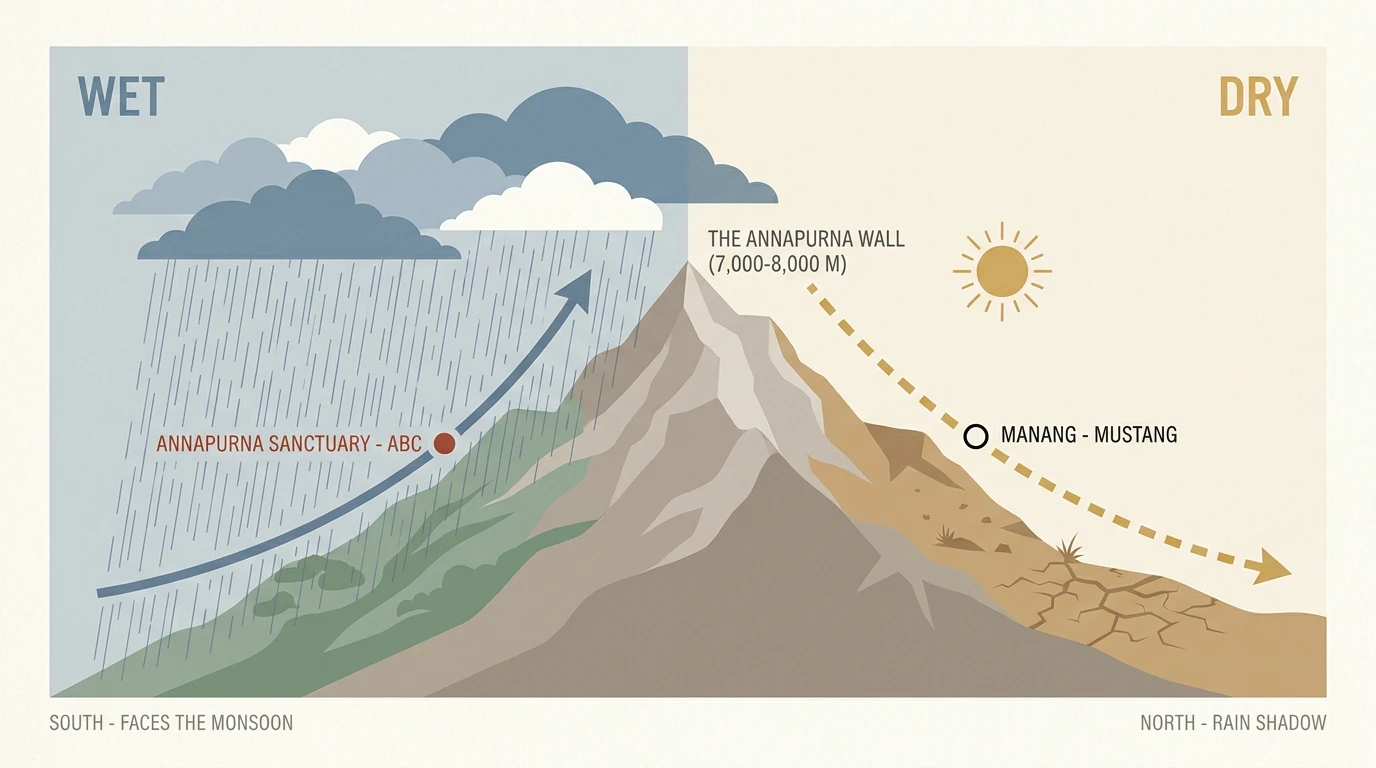
It’s the biggest reason ABC and the Circuit aren’t interchangeable when you’re picking dates: if your only free window is summer, the Circuit’s high, dry side is the better Annapurna option.
What we can say first-hand
We’re honest about the line between measured and sourced: everything about the seasons here is sourced general knowledge, corroborated across current Annapurna guides — not something we measured. The one first-hand point is the trek this whole site is built on, walked 19–24 October 2025 and recorded by Kani (the Ohana trip leader) on a COROS watch. That’s peak autumn — so when we say October is stable and clear, it’s the one month we can back with a file we actually hold. Spring, winter and monsoon stay clearly sourced until we’ve walked them.
Sources & notes
- Seasonal weather, temperatures and sanctuary conditions: corroborated across current 2025–2026 Annapurna Base Camp season guides and regional climate references.
- Upper-sanctuary avalanche risk (Machhapuchhre Base Camp to Annapurna Base Camp): consistent across ABC safety guidance and our own difficulty guide.
- First-hand data point: the measured 19–24 October 2025 trek recorded by Kani on a COROS watch. Kak Yaa, an experienced hiker who leads Malaysian groups (not a licensed guide), supplies trail testimony across our ABC coverage.
- Status: sourced ranges current to July 2026; mountain weather varies year to year — check a recent forecast and local advice before you commit. First-hand spring, winter and monsoon notes to follow after future treks.
Whatever the month, base camp sleeps at 4,131 m and the nights are cold — our altitude guide covers the risk no season removes, and the permits guide covers the ACAP you need year-round.
Educational planning content, not medical advice — high-altitude weather turns fast, and the upper sanctuary can carry avalanche risk after snow; check conditions locally before you go. Some links are affiliate links; we only recommend what we’d use ourselves, at no extra cost to you. © 2026 keitreks · The numbers are measured. The trail is next.
Related: Annapurna Base Camp itinerary · ABC trek difficulty · Altitude & acclimatisation · Permits & the guide rule · Everest Base Camp best time